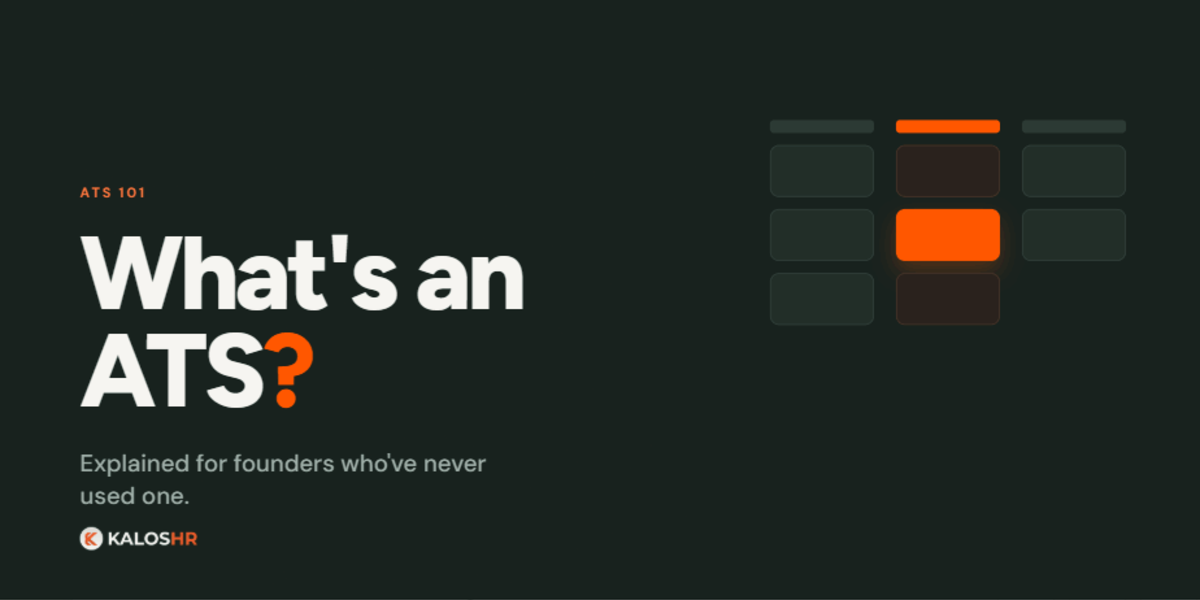
What's an ATS? Explained for founders who've never used one.
Somewhere in your search for a way to fix hiring, you hit the term "ATS." Everyone in recruiting uses it like it's obvious, nobody stops to explain it, and you nodded along rather than ask. So let's clear it up plainly, with no jargon and no assumption that you've ever used one.
If you're a founder or team lead hiring from your inbox, this is the explainer written for you.
ATS, in one sentence
ATS stands for applicant tracking system. Strip the acronym away and it's software that tracks every candidate through your hiring stages, from the day they apply to the day they accept, all in one place instead of scattered across your inbox.
That's the whole idea. Where email gives you a pile of messages, an applicant tracking system gives you a board that shows who applied, who you've spoken to, and who's next. Recruiters call this a "pipeline." You can call it a board that shows where every candidate stands.
What it does
A hiring platform handles the steps you're currently doing by hand:
Collects applications in one place. Every CV lands in one view, not your inbox, so nothing gets buried.
Tells you who's worth a call. It compares each applicant's answers against what your role needs and gives you a score, so you start with the strong people instead of reading all 40 in order.
Shows you a board of stages. Drag a candidate from "applied" to "interview" to "offer." One glance shows you the state of every role.
Books interviews without the back-and-forth. Candidates pick a slot from your availability, so you stop trading emails to find 30 minutes.
Sends the routine emails for you. Confirmations, shortlist notes, and rejections go out as you move people along, so nobody waits a week and nobody gets ghosted.
Lets you send the offer. When you've decided, the offer goes out from the same place, with a record of every step.
Put together, it turns hiring from a stack of separate chores into one connected flow.
"Isn't this only for big companies?"
That's the common assumption, and it used to be fair. For years, applicant tracking systems were built for HR departments and priced for them: hundreds a month, charged per seat, with setup that needed a sales call. A 10-person team took one look and went back to email.
Two things make that assumption outdated. First, smaller teams feel disorganised hiring more sharply, not less, because every hire carries more weight and there's no recruiting team to absorb the chaos. Second, the price barrier is gone. Tools built for growing teams now start free and charge a flat fee, so the structure that used to be a luxury for big companies is available to a five-person business today.
So the honest answer is yes, a small team benefits, often more than a big one. The question isn't your size. It's whether you're hiring more than once a year and tired of losing candidates to your inbox.
How to tell if you need one now
You don't need software for software's sake. You need it when the pile starts costing you. A few signs:
You can't quickly say who applied for a role and what stage they're at. Candidates wait days for a reply because the CV got buried. Scheduling a single interview eats half your week. You rewrite the same job post, the same questions, and the same rejection for every role. Your teammates can't see what's happening because it all lives in your inbox.
If two or three of those ring true, you've outgrown email, and a hiring platform is the fix.
What to look for
If you decide to try one, a small team should want: fast setup measured in minutes, not a sales call; a branded careers page candidates apply to directly; automatic scoring so you shortlist by fit; a visual board you and your team can see; built-in scheduling and emails; and honest pricing with a free plan and no per-seat fee. Skip anything that buries those basics under enterprise features you'll never use.
KalosHR is built around exactly that list: post a job, score applicants automatically, move them through a visual pipeline, book interviews, and send the offer, all in one place, free to start. You can have your first role live in about ten minutes and see what the term means in practice.
Now you know what an ATS is. The harder part, deciding it's time to leave the inbox, you probably already knew.