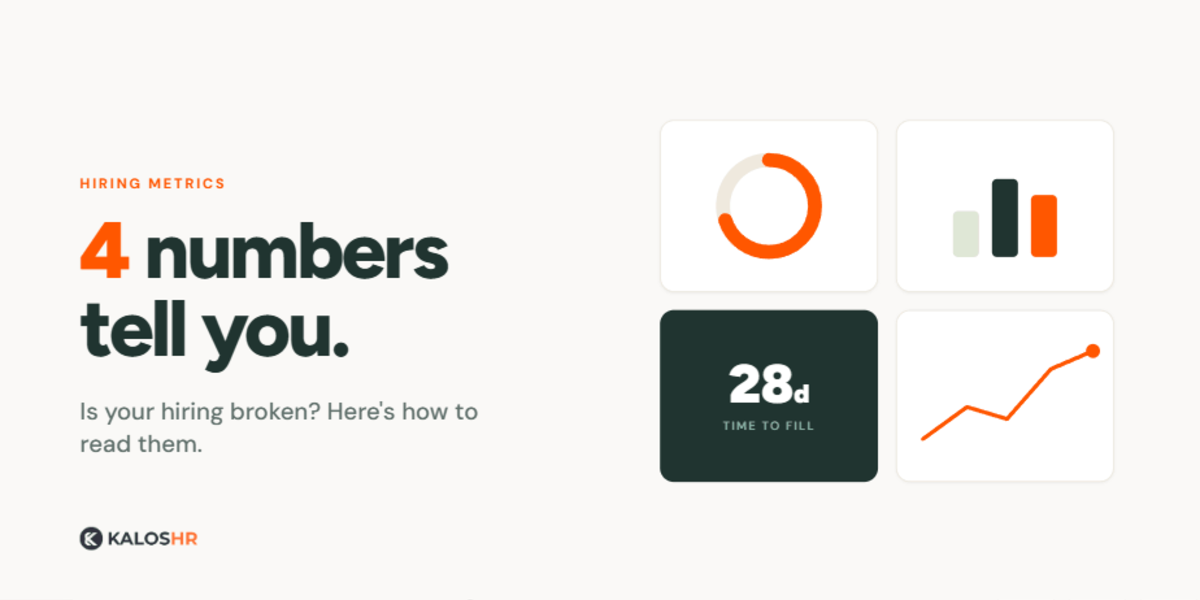
Four numbers tell you if your hiring is broken. Here's how to read them.
Most small teams hire on instinct and only realise something's wrong when a role drags for two months or a new hire quits in week three. By then the damage is done and you can't say why. You don't need a data team or a dashboard to catch this earlier. Four numbers tell you whether your hiring works, and each one points to a specific thing to fix.
Track these and you'll see problems while you can still do something about them.
1. Time to hire: how fast you move
This is the number of days from when someone applies to when they accept your offer. It's the single most telling figure in hiring, because speed decides who you can land. The best candidates are off the market in days, so a slow process means you're often choosing from whoever's left.
How to read it: If your time to hire runs into many weeks, break it down by stage to find the slow one. Usually it's scheduling or a manager sitting on a decision. Fix the slowest stage and the whole thing speeds up.
What good looks like: Fast enough that you rarely lose a candidate to a competitor who simply moved quicker.
2. Applicants per role: whether your top of funnel works
Count how many people apply to each opening. This tells you if enough of the right people are even seeing your role. Too few, and you've got a reach or appeal problem. A flood of clearly unqualified applicants, and your post is pulling the wrong crowd.
How to read it: Low numbers point to your job title, your pay range, or where you're posting. High but weak numbers point to vague requirements letting the wrong people through. Either way, the job post is usually the lever.
What good looks like: A healthy handful of qualified applicants per role, not zero and not two hundred mismatches.
3. Conversion between stages: where you leak
This is the share of candidates who move from one stage to the next: application to screen, screen to interview, interview to offer, offer to acceptance. A sharp drop at any step shows exactly where your process loses people, which turns a vague "hiring is hard" into a specific thing to fix.
How to read it: Find your steepest drop and investigate it. Few applicants reaching interview means your screening or your post needs work. Offers getting declined points to pay, speed, or how the offer was made.
What good looks like: No single stage where most of your candidates quietly fall out.
4. Offer acceptance rate: whether you close
Of the offers you make, how many do people say yes to? A low rate is expensive, because you've done all the work of finding and vetting someone only to lose them at the finish line. It almost always signals a problem with pay, with speed, or with how the offer was handled.
How to read it: If candidates keep declining, check your salary ranges against the market, close the gap between deciding and sending the offer, and make the offer itself warmer and clearer. Asking about salary expectations early, at the application stage, stops most of these surprises.
What good looks like: Most of your offers turning into hires, because nothing about the offer is a shock.
Start with two, not four
You don't have to track all four from day one. Start with time to hire and conversion between stages, because together they catch the most common problems: moving too slowly, and leaking candidates at a specific step. Add the other two as you grow.
The reason small teams skip this isn't laziness. It's that pulling these numbers out of an inbox and a spreadsheet is painful enough that nobody bothers. That changes when your hiring runs in one place. In KalosHR, your dashboard shows applicant counts, where candidates come from, your interview schedule, and how they convert across stages, without you building a single report. The numbers are there, because every applicant and decision already lives in the system.
You can't fix what you can't see. Watch these four and your hiring stops being a mystery and starts being something you improve on purpose.